 info@gkvllp.com
Modern commercial buildings are more connected, complex and active than ever before. Corporate offices, hospitals, schools, hotels, warehouses, retail spaces and industrial facilities may have hundreds or even thousands of people moving through them every day.
With this level of activity, relying on a single security device is no longer enough. A CCTV camera may record an incident, but it cannot prevent an unauthorized person from entering a restricted area. An access-control system may secure a door, but without proper surveillance, facility managers may not have complete visibility of what is happening around the building.
This is where an integrated security system becomes essential.
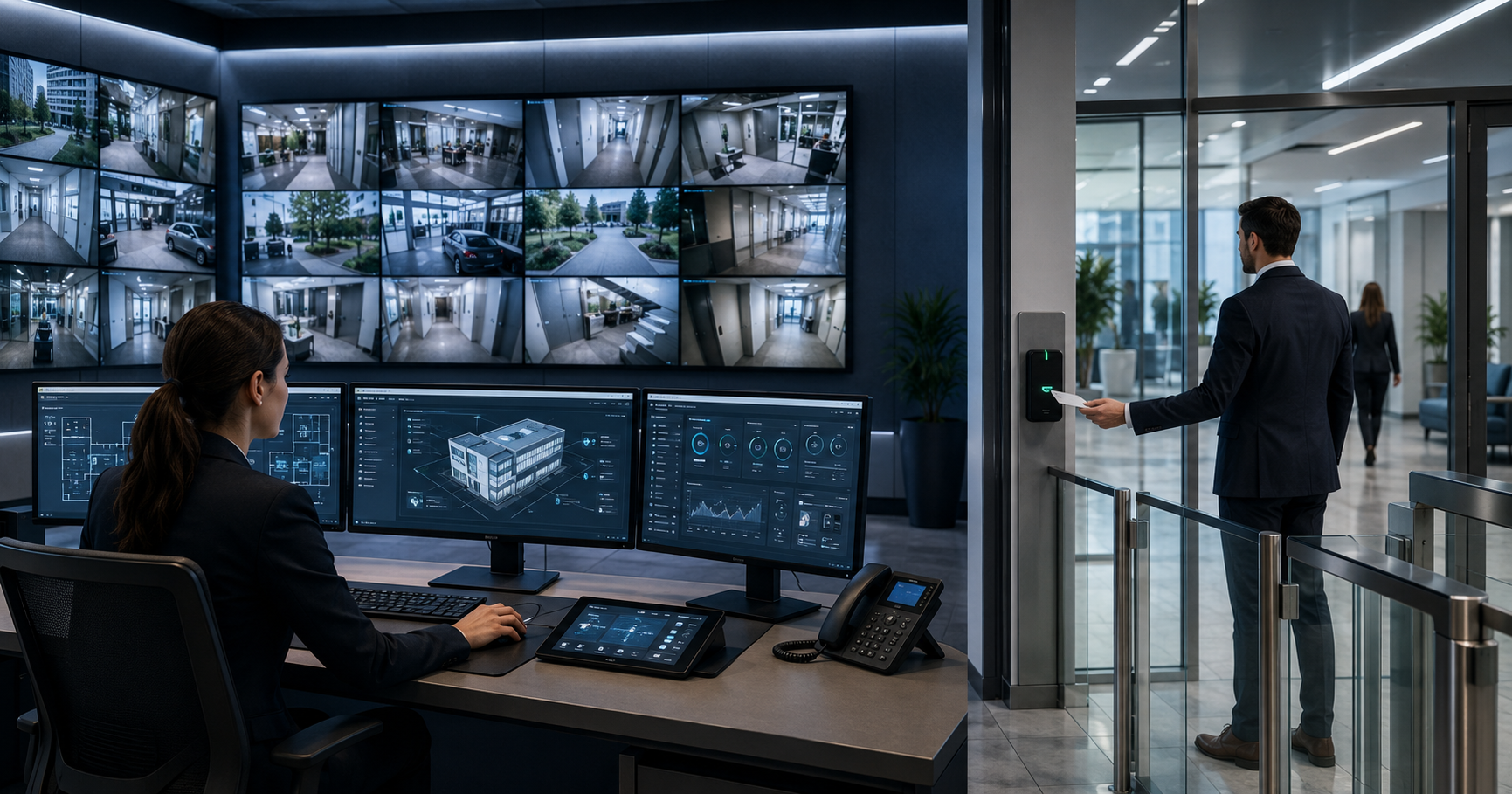
An integrated security system connects different technologies such as CCTV surveillance, access control, alarm systems, networking and communication systems into a coordinated security environment. Instead of operating independently, these solutions work together to improve protection, monitoring and operational control.
What Is an Integrated Security System?
An integrated security system combines multiple security technologies on a common infrastructure or management platform.
Depending on the requirements of the property, the system may include:
- CCTV and video-surveillance cameras
- Network video recorders and digital video recorders
- Access-control systems
- Biometric or card-based entry systems
- Intrusion alarms
- Fire-alarm systems
- Public-address systems
- Networking and structured cabling
- Central monitoring and alert systems
The objective is to provide facility managers with a clearer and more complete view of the building.
For example, when an unauthorized access attempt takes place, the access-control system can create an alert while the nearest CCTV camera records the event. Security personnel can immediately review the footage and take the necessary action.
Better Visibility Across the Property
One of the biggest advantages of an integrated security system is improved visibility.
A properly designed CCTV network can help monitor entrances, corridors, parking areas, reception zones, warehouses, production areas and other critical locations. Depending on the site, dome cameras, bullet cameras or PTZ cameras can be selected for different monitoring requirements.
Instead of depending only on physical security personnel, organizations can use surveillance technology to continuously observe key areas and maintain recorded evidence of incidents.
Centralized monitoring also allows authorized personnel to view multiple locations from one control room. This can be particularly valuable for large campuses, warehouses, hospitals, factories and multi-floor commercial buildings.
Stronger Access Control
Not every person should have access to every area of a building.
Sensitive locations such as server rooms, record rooms, laboratories, cash-handling areas, storage facilities and management zones require controlled entry.
An access-control system allows organizations to decide who can enter a particular area and at what time. Entry can be managed through access cards, biometric readers, PIN-based systems or other authentication methods.
The system can also maintain a record of entry and exit activity. This provides greater accountability and helps management investigate unusual movement or unauthorized access attempts.
When access control is connected with CCTV surveillance, security teams can verify both the identity and activity of individuals entering restricted zones.
Faster Response to Security Incidents
The effectiveness of any security system depends on how quickly an organization can respond to an incident.
Integrated systems can generate real-time notifications for events such as unauthorized entry, suspicious movement, door violations, equipment failure or emergency conditions.
These alerts allow security teams to identify the location of the problem and respond without unnecessary delay.
A public-address system can also be used to communicate instructions during an emergency. In a large building, clear communication is essential for guiding employees, visitors or residents toward safe exits and designated assembly areas.
Improved Operational Efficiency
Integrated security systems do more than protect a property. They can also support daily operations.
Recorded video may help management review workplace incidents, verify deliveries, investigate inventory movement and resolve disputes. Access records can support attendance monitoring and contractor management.
Centralized systems also reduce the need to manage separate devices through multiple interfaces. A well-planned solution provides a more organized approach to security management, reporting and maintenance.
This makes the system easier for facility managers, administrators and security personnel to operate.
Scalable for Future Requirements
Businesses grow, offices expand and operational requirements change.
A good security system should be designed with future expansion in mind. Organizations may initially install surveillance and access control at one location and later extend the system to additional floors, warehouses, branches or facilities.
Using appropriate network infrastructure, structured cabling and compatible devices makes it easier to add new cameras, entry points, recording capacity or monitoring stations.
Scalability helps businesses avoid replacing the entire system whenever their security requirements increase.
Why Professional System Design Matters
The performance of an integrated security solution depends heavily on proper planning.
Before selecting equipment, the site should be carefully evaluated. Camera locations, lighting conditions, blind spots, entry points, network capacity, storage requirements and operational risks must all be considered.
A professionally managed project generally includes:
- Requirement consultation
- Site survey and risk assessment
- System design
- Product selection and sourcing
- Installation and structured cabling
- Testing and commissioning
- User training and handover
- Documentation
- Maintenance and technical support
This end-to-end approach helps ensure that the installed system is practical, reliable and suitable for the property.
The Importance of Annual Maintenance
Even high-quality security equipment requires regular inspection and maintenance.
Dust, damaged cables, network issues, storage failure, camera misalignment or outdated system settings can reduce performance. Without periodic checks, organizations may discover a problem only after an important incident has occurred.
An Annual Maintenance Contract helps keep the system operational through scheduled inspection, preventive maintenance, troubleshooting and technical support.
Regular maintenance also helps extend equipment life and reduce unexpected downtime.
Choose a Complete Security Solutions Partner
Commercial security should not be treated as a collection of disconnected products. It should be planned as a complete system that supports prevention, monitoring, response and long-term reliability.
GKV LLP provides integrated infrastructure and security solutions for corporate offices, commercial buildings, healthcare facilities, educational institutions, industrial units, warehouses, hospitality businesses, residential complexes and other environments.
From site survey and system design to product supply, installation, testing, commissioning and AMC support, GKV LLP provides a single point of coordination throughout the project.
A well-designed integrated security system helps create a safer, smarter and more manageable building.
To discuss your commercial security requirements, contact GKV LLP at +91-6296179627 or info@gkvllp.com.